A Buyer’s Guide to Verifying Legitimacy and Navigating Custom Import Challenges
Why Certification Matters When Importing Motorcycle Wheels into Europe
When you’re importing motorcycle wheels—whether for road-legal builds or custom projects—the topic of certification is unavoidable. European markets are regulated, and customs officials, inspection centers, and even end customers often expect proof of safety and compliance. Two certifications you’ll hear most often:
- ECE Certification (E-mark) — the European standard, especially UNECE Regulation 124 for alloy wheels.
- DOT Registration — the U.S. standard managed by the Department of Transportation.
While both serve different markets, each acts as a trust signal that the wheel meets certain technical and safety standards. And for European importers, especially those dealing with aftermarket or custom builds, understanding how to evaluate certification—or acceptable alternatives—is critical.
What Is ECE (E-mark) and How Does It Apply to Motorcycle Wheels?
ECE (or “E-mark”) certification refers to compliance with UNECE regulations. The most relevant for wheels is UNECE R124, which sets standards for impact strength, fatigue resistance, and durability. E-marked wheels typically carry a stamped code (e.g., E4, E1) indicating country of approval and regulatory compliance.
For full homologation, a motorcycle wheel must:
- Pass radial fatigue and bending fatigue tests
- Meet material composition requirements
- Be traceable through documentation and labeling
💡 Note: E-mark approval is more common for automobile wheels. In the motorcycle aftermarket, especially for custom forged or laced wheels, many products are not type-approved under ECE due to cost or volume limitations.
What About DOT Certification?
DOT (U.S. Department of Transportation) certification applies mainly to wheels for the U.S. market. A DOT-approved wheel must meet minimum performance standards (based on SAE and JWL testing) and is usually stamped with a DOT code.
While DOT approval isn’t mandatory for EU imports, it can:
- Help indicate a wheel has passed recognized testing protocols
- Offer buyers confidence in structural integrity
- Be considered a secondary quality assurance layer
🚫 However, DOT alone does not substitute for E-mark when registering motorcycles in the EU. It may satisfy custom shops or private builds, but registration authorities in Europe prioritize ECE regulations.
Reality Check: Why Many Aftermarket Motorcycle Wheels Aren’t Certified
Here’s where things get practical. Many wheels used in custom builds don’t have full E-mark or DOT certification. Why?
- Volume: Certification testing is expensive—suppliers often skip it for low-run or one-off designs.
- Customization: Modified dimensions, finishes, or spoke patterns may invalidate prior approvals.
- Market Use: Many wheels are designed for track use, show bikes, or off-road models—where full road certification isn’t mandatory.
This doesn’t mean the wheel is low quality. But as a buyer, you’ll need to look beyond a simple “certified / not certified” label.
What You Should Ask Suppliers Instead (When Certification Is Missing)
If your target wheel lacks E-mark or DOT labels, shift your focus to evidence of manufacturing credibility and component traceability. Here’s what to request:
✅ 1. Engineering Test Reports
Ask for lab results (or in-house reports) showing:
- Radial fatigue
- Bending fatigue
- Impact resistance
These demonstrate structural reliability—even without formal certification.
✅ 2. Material Certificates
Verify:
- The aluminum grade used (e.g., 6061-T6 forged)
- Heat treatment process
- Non-destructive testing (NDT) documentation
Helps confirm the wheel is built to global metallurgical standards.
✅ 3. Supplier Quality Certifications
Look for:
- ISO 9001
- IATF 16949
- CE marking (if relevant for packaging or logistics)
Shows a systemic approach to quality—not just one-off parts.
✅ 4. EU Import Case Studies
Has the supplier shipped to Europe before?
- Get references from EU shops
- Ask for photos of installations on street-legal motorcycles
- Request any customs clearance records or inspection forms
These reduce import uncertainty and build practical trust.
✅ 5. Clear Warranty and After-Sales Policy
Professional suppliers should offer:
- Written product warranty (1–2 years minimum)
- Replacement parts (hub, rim, spokes)
- Assistance with documentation for national inspections
Shows they stand behind their product—not just sell and vanish.
What Happens at EU Customs or Registration (And How to Prepare)
Even when a wheel isn’t fully certified, buyers can still legally import and register—if they prepare properly. Here’s how:
| Step | What to Do | Why It Matters |
|---|---|---|
| 1. | Gather all documentation: invoices, specs, materials, photos | Customs needs traceability |
| 2. | Ask supplier for load rating, size specs, and test reports | Used in safety inspections |
| 3. | Check national regulations (e.g., TÜV in Germany, SFRO in Sweden) | Some countries allow individual approval |
| 4. | Include wheel data in your build’s homologation file | Required for road registration |
| 5. | Avoid generic markings (e.g., fake E-mark or DOT) | Misleading marks = seizure or fines |
🛠️ If you’re working with a local tuner or registration consultant, share the full wheel documentation with them upfront. It may reduce the time and cost of technical inspections.
What Type of Buyer You Are—and What You Should Prioritize
Not all buyers face the same pressure for certification. Identify your scenario:
| Buyer Type | Priority | Certification Needed? |
|---|---|---|
| 🇸🇪 Custom shop (Sweden) | Road registration | ✅ ECE or equivalent documents |
| 🇩🇪 TÜV-focused builder (Germany) | National approval | ✅ Certified or testable wheels |
| 🇮🇹 Tuning shop (Italy) | Style + resale value | ✅ Certification increases value |
| 🇦🇺 Track-only builder | Performance focus | ❌ Not required, but test reports help |
| 🌍 eCommerce importer | Customs clearance | ✅ Documentation critical to avoid delays |
If you’re unsure, assume that certification—or at least detailed documentation—is a must-have.
Final Checklist for Buyers
Before confirming an order, make sure you:
✅ Know whether you need full certification
✅ Understand what’s stamped on the wheel (E-mark, DOT, or none)
✅ Received lab test data or material certificates
✅ Got at least one EU case reference
✅ Reviewed after-sales policy and warranty
✅ Checked with your local registration authority
Summary
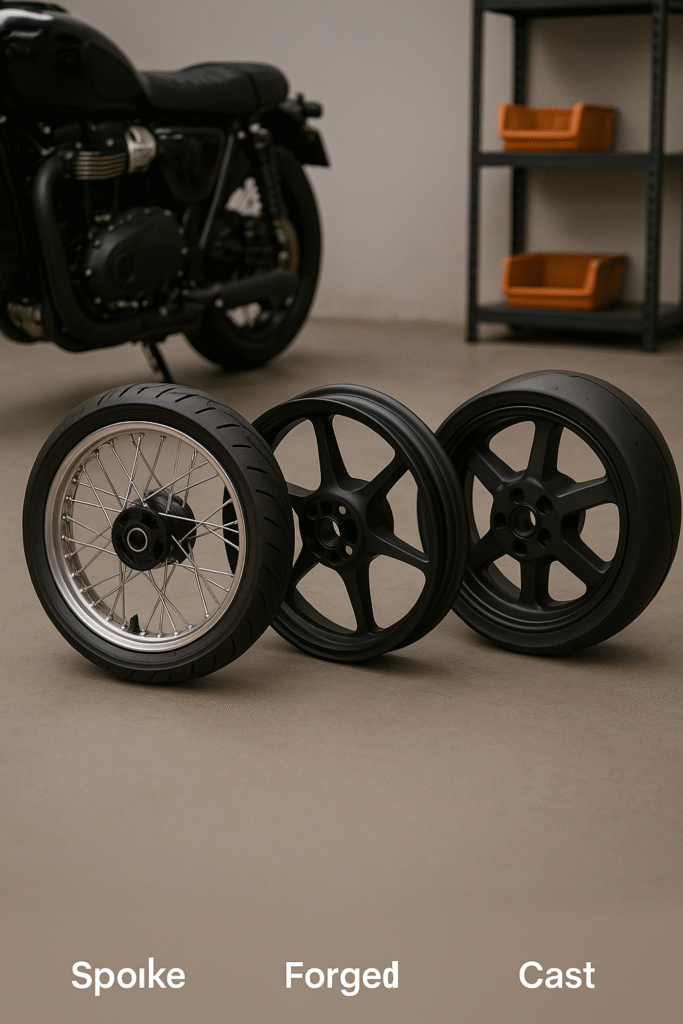
Buying and importing motorcycle wheels into Europe is not just about picking a beautiful set of rims. Whether you’re sourcing cast, forged, or laced wheels, certification (or its absence) impacts your ability to register and legally use the bike.
While many aftermarket wheels may not carry E-mark or DOT certification due to their custom nature, that doesn’t automatically make them untrustworthy. What matters is how the supplier proves quality, how transparent they are with documentation, and how well they support your process.
As a buyer, your goal is to minimize risk—legally and mechanically. So ask for more than just a product catalog. Ask for proof. Ask smart. And if a supplier can’t provide it, move on.