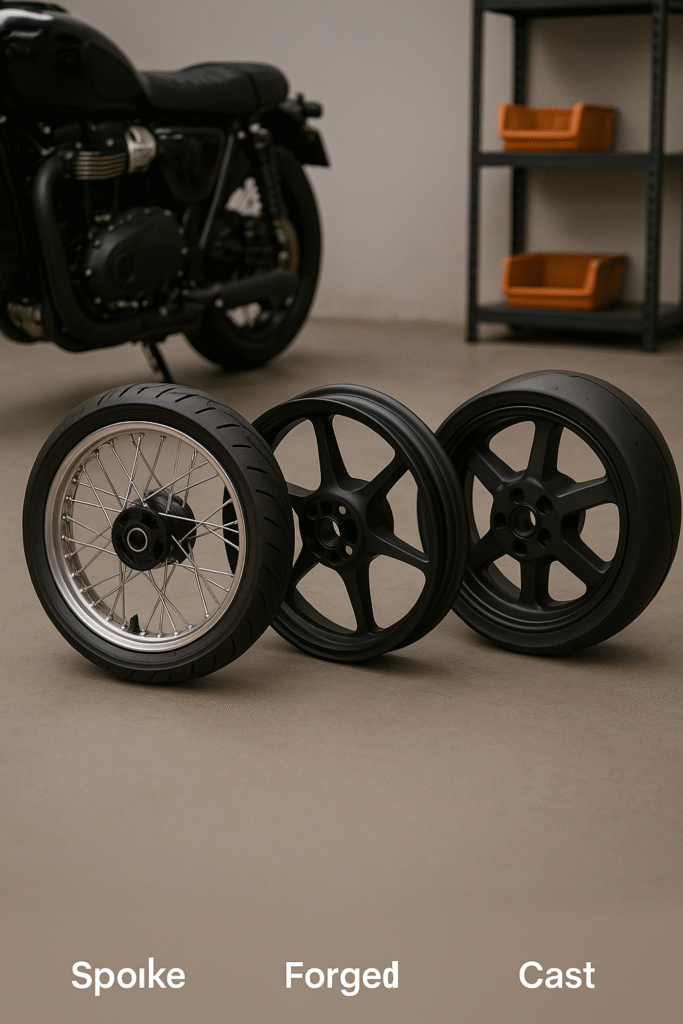
When buyers search for aluminum alloy wheel heat treatment, they usually want one clear answer: which alloy is used, why it is used, and how heat treatment changes real-world wheel performance. In motorcycle wheels, the most common answers are straightforward. Cast wheels are often based on A356/A356.0 aluminum casting alloys and then brought to a T6 temper, while forged wheels are commonly built from 6xxx-series wrought alloys, especially 6061-T6 and, in many European supply chains, 6082-T6. These combinations dominate because they balance weight, strength, corrosion resistance, finish quality, manufacturability, and cost.
Thank you for reading this post, don't forget to subscribe!What “aluminum alloy wheel heat treatment” actually means
In aluminum terminology, T6 means the material has been solution heat treated and then artificially aged. In practical terms, the alloy is heated so key elements go into solid solution, then cooled quickly enough to retain that state, and finally aged in a controlled way to build the strength and hardness the part needs. That sequence is the heart of modern aluminum wheel metallurgy, whether the wheel began life as a casting or as a forged blank.
That matters because the alloy name alone does not tell the whole story. A wheel made from a good alloy but processed poorly will not perform like a properly qualified wheel. The Aluminum Association notes that each temper designation represents a specific processing path tied to minimum mechanical properties, and it explicitly warns against assuming one temper can simply substitute for another. For B2B buyers, that means alloy, temper, process control, and test documentation belong together.
Why cast motorcycle wheels often use A356-T6
For cast motorcycle wheels, A356/A356.0 remains a logical choice because it is an Al-Si-Mg casting alloy with silicon and magnesium levels that support both good castability and strong heat-treatment response. Published composition data for A356-family alloys shows about 6.5–7.5% silicon and roughly 0.30–0.45% magnesium, which helps the metal fill complex spoke and rim shapes while still responding well to T6 processing afterward.
The mechanical-property standards explain why A356 is so common. The Aluminum Association’s published casting-property tables list A356.0-T6 with minimum values around 34 ksi (235 MPa) ultimate tensile strength, 24 ksi (165 MPa) yield strength, and 3.5% elongation, along with a typical Brinell hardness range of 70–105 HB. Those numbers are not the whole wheel story, because finished-wheel geometry and process quality still matter, but they show why A356-T6 gives cast wheels a very workable balance of stiffness, strength, and usable ductility for road applications.
This is also why many OEM-style and aftermarket street wheels stay with cast A356-type material instead of chasing exotic alloys. Casting lets manufacturers build intricate spoke forms at scale, hold cost in check, and still achieve solid performance once the wheel is properly heat treated. For brands selling into wholesale and replacement markets, that mix of design freedom, stable production, and acceptable mechanical performance is hard to beat.
Why forged motorcycle wheels often use 6061-T6 or 6082-T6
On the forged side, 6061 has become one of the most familiar heat-treatable aluminum choices because the 6xxx series is built around magnesium and silicon, is known for good corrosion resistance, and is widely used where moderate-to-high strength is needed. The Aluminum Association describes 6xxx alloys as heat treatable and corrosion resistant, and identifies 6061 as the most widely used alloy in the series. Published mechanical-property tables for 6061-T6 extruded bars and profiles list typical minimums around 38 ksi tensile and 35 ksi yield, with elongation commonly in the 8–10% range depending on section size.
In practice, 6061-T6 is popular because it gives wheel manufacturers a strong blend of strength-to-weight ratio, machinability, surface finish, weldability in related components, and corrosion resistance. It also accepts coatings well, which matters for anodized, painted, or polished aftermarket wheels. That is a big reason why 6061-T6 is so often associated with premium forged wheels aimed at performance street bikes, sport bikes, and custom builds.
6082-T6 deserves special attention for export-oriented motorcycle parts businesses because it is common in Europe and is often positioned as a step up in strength within the 6xxx family. Hydro states that 6082 has similar but not equivalent characteristics to 6061 and offers slightly higher mechanical properties in the T6 condition. Hydro also describes 6082 as having strong corrosion resistance, good machinability, and a good response to anodizing and painting, which helps explain why buyers in high-stress, appearance-sensitive applications often prefer it.
A published Hydro declaration for EN AW-6082 T6 further shows why the alloy is attractive in structural-grade applications: depending on product form and thickness, the listed minimum tensile and yield strengths are positioned above many standard 6061-T6 values. The important procurement point is not that an extrusion table can be copied directly onto a forged wheel, but that 6082-T6 is recognized in the market as a higher-strength 6xxx option with strong finishing and corrosion behavior, which is exactly why it appears so often in European engineering and transport supply chains.
Casting vs. forging: why process matters as much as alloy
Alloy selection is only half the decision. Casting and forging create very different starting structures before heat treatment even begins. The Forging Industry Association explains that forging refines grain structure, develops more favorable grain flow, and improves properties such as ductility, impact toughness, fracture toughness, and fatigue strength. It also notes that forgings offer strong material uniformity and a more predictable response to heat treatment than many alternative processes.
That is why forged 6061-T6 or 6082-T6 wheels are usually marketed for more aggressive weight reduction and harder use. Better grain flow and lower internal porosity help engineers push thinner sections while still protecting fatigue life and impact margin. Cast A356-T6 wheels can still be excellent for street and many performance applications, but forged wheels generally give designers a bigger safety window when chasing lower mass and more demanding load cases.
A simple heat-treatment flowchart for motorcycle wheels
A useful way to understand aluminum alloy wheel heat treatment is to picture the production route in two short maps:
Cast wheel route: Alloy melt → wheel casting → solution heat treatment → quench → artificial aging to T6 → machining/finishing → inspection and validation.
Forged wheel route: wrought billet → forging/forming → machining → solution heat treatment → quench → artificial aging to T6 → finishing → inspection and validation.
The key idea is that heat treatment is not a cosmetic add-on. It is the step that converts a workable aluminum shape into a wheel material with the strength, hardness, and durability profile expected from a modern road or performance product. Without that controlled sequence, the same alloy would not deliver the same service behavior.
How heat treatment changes real-world wheel performance
For riders and buyers, the effects show up in four places: strength, fatigue resistance, stiffness feel, and finish durability. T6 processing increases the strength level compared with softer or as-fabricated conditions, which helps the wheel resist bending and permanent deformation under braking, cornering, and impact loads. At the same time, the final design still has to preserve enough ductility that the wheel deforms in a controlled way instead of failing abruptly. That balance is why wheel engineering is never just “harder is better.”
Heat-treated 6xxx alloys also pair well with premium finishing. Official supplier data for 6061 and 6082 repeatedly highlights good corrosion resistance and good response to coatings, anodizing, or painting. For importers and custom shops, that matters because finish quality is not just aesthetic; it affects long-term appearance, cleaning, and environmental durability in wet, salty, or coastal markets.
Quick comparison table
| Wheel type | Common alloy & temper | Why it is used |
|---|---|---|
| OEM-style cast street wheel | A356/A356.0-T6 | Strong castability, good balance of strength and ductility after heat treatment, cost-efficient production |
| Premium forged wheel | 6061-T6 | Widely used heat-treatable 6xxx alloy with strong strength-to-weight balance, corrosion resistance, and finish quality |
| Premium forged wheel for high-stress applications | 6082-T6 | 6xxx alloy with slightly higher T6 mechanical properties than 6061 in many published product standards, plus good corrosion resistance and anodizing response |
These summaries reflect published Aluminum Association and Hydro data, but exact finished-wheel performance still depends on form, section thickness, forging or casting quality, machining strategy, and validation testing. Buyers should always review the supplier’s alloy/temper declaration together with inspection and test records.
What serious buyers should ask a wheel supplier
If you are sourcing aftermarket or OEM-style motorcycle wheels, ask five questions before you compare price. Which alloy is used? Which temper is specified? What heat-treatment route is qualified? What standard or internal test method verifies the result? What documents ship with the wheels? Those questions matter because the same marketing phrase—“forged aluminum wheel” or “T6 wheel”—can still hide big differences in material control.
For B2B purchasing teams, the best suppliers are the ones that connect material language to documentation: alloy designation, temper, batch traceability, dimensional checks, and fitment validation. In other words, the right conversation is not just “Is it aluminum?” but “Which aluminum, processed how, and verified by what?” That is the difference between a catalog claim and a dependable export product.
FAQ
Is forged always better than cast for motorcycle wheels?
Not automatically. Forging generally offers better grain flow, uniformity, and fatigue-related advantages, but a well-made cast A356-T6 wheel can still be an excellent choice for many street and replacement applications. The right answer depends on target weight, price, use case, and validation level.
What does T6 mean on an aluminum wheel?
T6 means the aluminum has been solution heat treated and then artificially aged to achieve a defined mechanical-property condition. It is one of the most important temper designations in wheel materials because it turns a workable alloy into a higher-strength service condition.
Is 6082-T6 better than 6061-T6?
In many published standards, 6082-T6 is positioned slightly above 6061-T6 in mechanical properties, and it is widely favored for high-stress structural use in Europe. But “better” depends on the application, form, supplier capability, and certification route. For motorcycle wheels, the smarter question is which alloy-process package gives the best balance of weight, fatigue margin, finish quality, and supply consistency.
In the end, aluminum alloy wheel heat treatment is about choosing the right material family and then processing it correctly. A356-T6 remains the backbone of many cast motorcycle wheels. 6061-T6 remains the global benchmark for many forged designs. 6082-T6 is an increasingly important high-strength 6xxx option, especially for Europe-focused supply chains. For riders, shops, and importers alike, the best wheel is not simply the lightest or the most expensive one—it is the one whose alloy, temper, process, and documentation all line up.