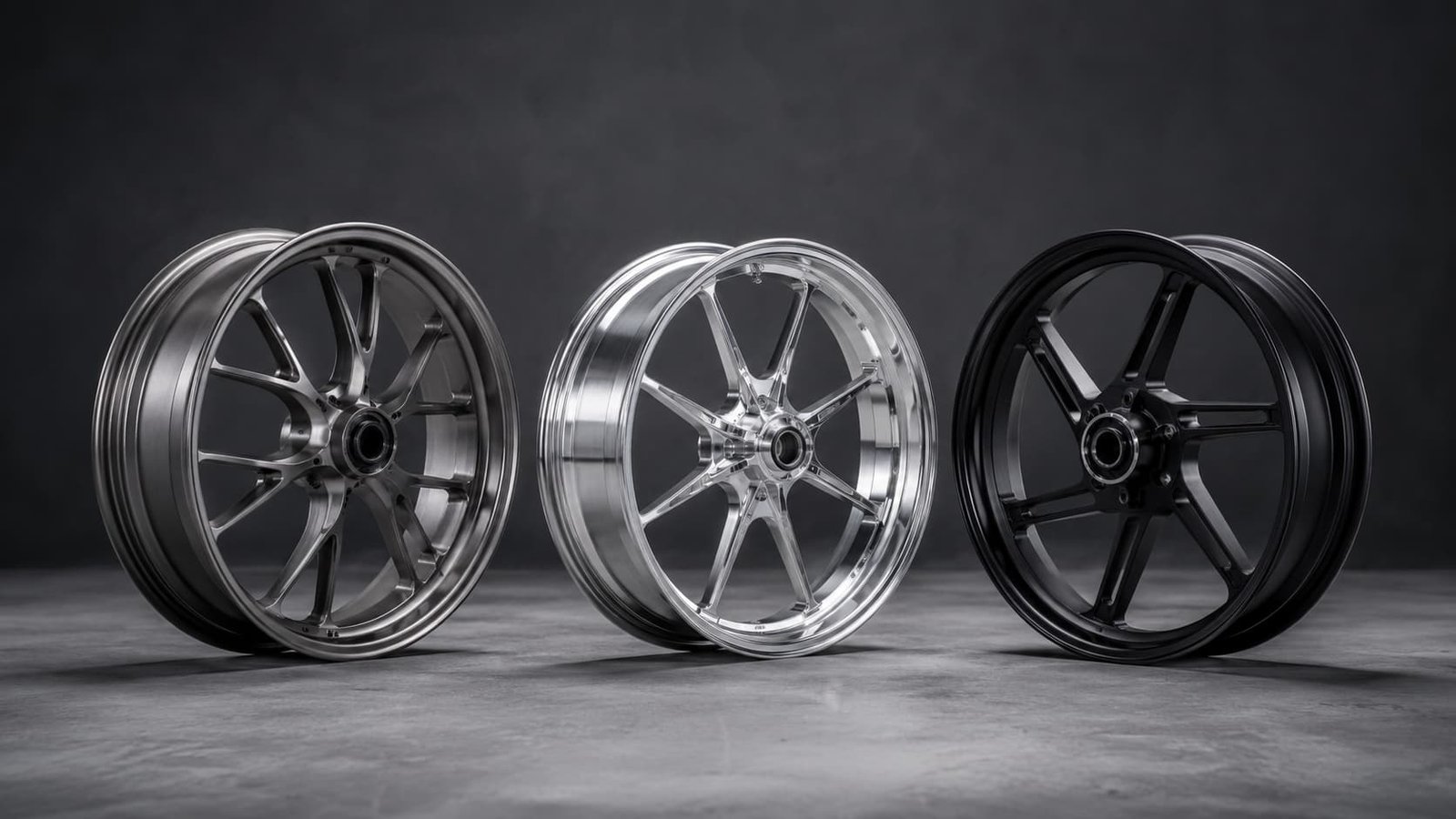
To start a motorcycle wheel brand you need four things: a defined niche, a manufacturing partner that owns its own forging and CNC lines, a private-label package (logo engraving, center caps, packaging, documentation), and a landed-cost model that still leaves margin for your sales channel. Everything else — website, ads, trade shows — is downstream of those four. Most new wheel brands do not fail because of marketing; they fail because they bought stock they could not fit, could not certify, or could not price competitively once freight and duty were added.
The Short Answer (TL;DR)
Pick one segment first (sportbike, cruiser, adventure, or maxi-scooter) instead of trying to cover all of them. Source directly from a real factory rather than a trading company, so you control tooling, quality and lead time. Start with a sample set to validate fitment and finish before committing to inventory. Build your brand identity into the product itself — engraved logo, custom center caps, branded packaging — because that is what stops your wheels from being a commodity. Then price backwards from your channel: retail price minus channel margin minus duty and freight tells you the unit cost you can afford.
Step 1: Choose a Niche Before You Choose a Wheel
New brands almost always start too broad. A focused catalogue of 3–5 SKUs for one riding segment sells faster than 30 SKUs spread across everything, because it lets you own a keyword, a forum, and a group of installers.
| Segment | Wheel type buyers expect | Typical sizes | What sells the product | Brand entry difficulty |
|---|---|---|---|---|
| Sportbike / track | Forged aluminium or magnesium | 17″ front and rear | Weight saving, spoke design, track credibility | High competition, high price tolerance |
| Cruiser / custom | Forged billet, wide styling | 16″–21″ front, wide rear | Style, finish, custom engraving | Medium — style-led, less spec-led |
| Adventure / touring | Laced (spoked), tubeless options | 19″/21″ front, 17″/18″ rear | Durability, repairability, load rating | Medium — loyal, technical buyers |
| Maxi-scooter / commuter | Forged lightweight | 13″–15″ | Price, colour options, volume | Lower — volume-driven markets |
Your niche also decides your manufacturing route. Sportbike and cruiser brands generally build on forged motorcycle wheels; adventure brands need a supplier that also runs laced wheel assembly. Choosing a factory that covers both means you can extend the catalogue later without re-sourcing.

Step 2: Find a Manufacturing Partner, Not a Reseller
This is the decision that determines your margin, your lead time and your ability to fix problems. Many “manufacturers” listed on B2B platforms are trading offices that place your order with a third-party workshop you never see.
| What you should check | Real factory | Trading company |
|---|---|---|
| Equipment | Own forging press and CNC lines; can show the floor on video call | Shows photos it cannot walk you through live |
| Custom designs | Works from your drawing or 3D render; controls tooling | Limited to whatever the sub-supplier already produces |
| Lead time control | Schedules your order in its own production plan | Queues behind the workshop’s other clients |
| Quality response | Traces the batch, corrects the process | Passes the complaint down the chain |
| Price structure | Factory price | Factory price plus a margin you cannot see |
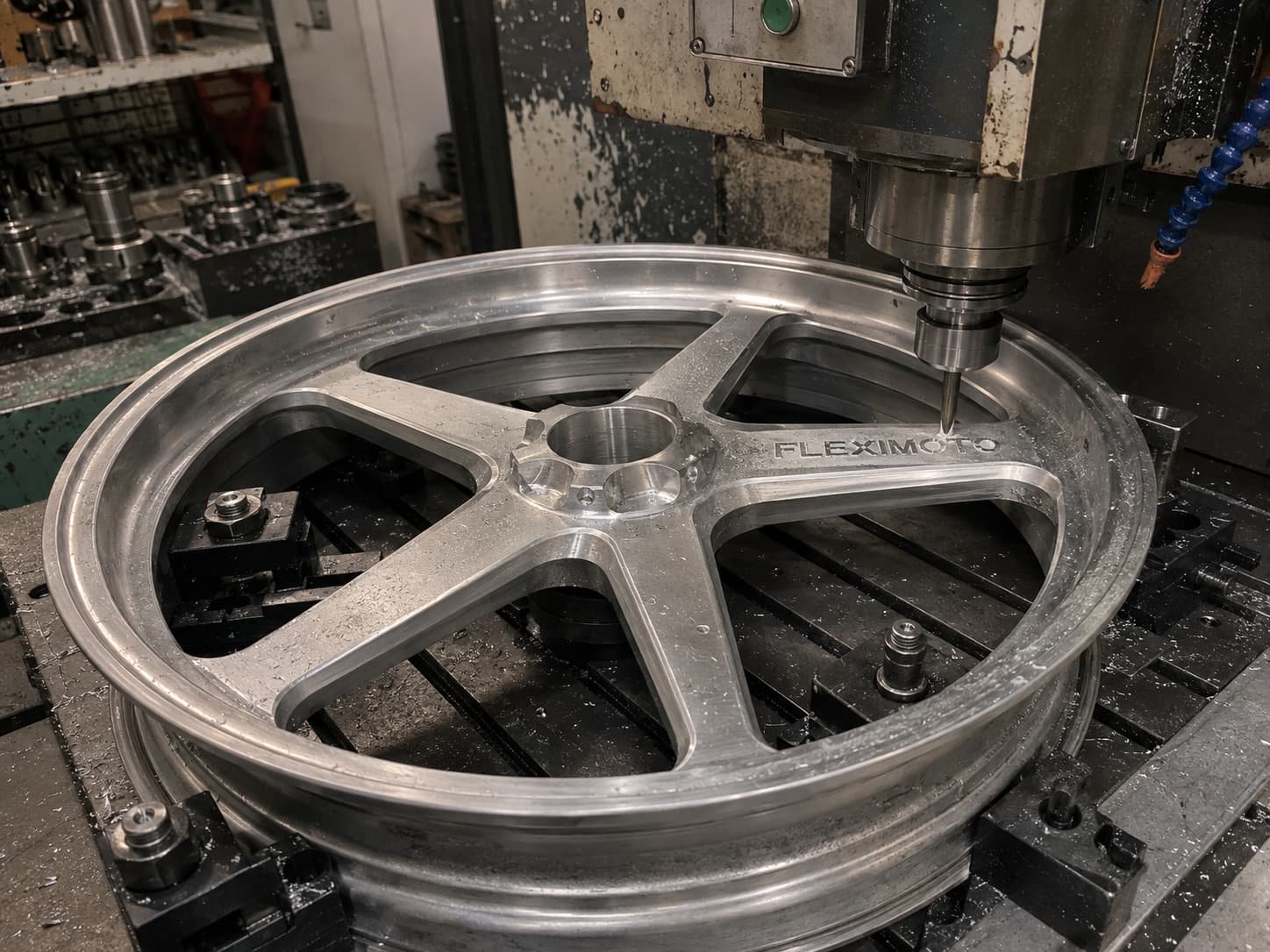
Ask directly: do you own your forging equipment, or do you outsource it? Can I see the CNC line on a live video call? Which of my parts are made in-house and which are bought in? A supplier that answers those clearly is one you can build a brand on. FLEXIMOTO operates its own forging and CNC lines in Shapingba District, Chongqing — you can read how that works on our why FLEXIMOTO page.
Step 3: Turn a Product Into a Brand
A wheel becomes your wheel through four layers of customisation. Decide which of these you want before you request a quote, because each affects price and lead time.
- Design ownership. Either an exclusive spoke design developed from your drawing or 3D concept, or an existing profile customised with your specification. Exclusive designs cost more but stop competitors selling the same silhouette.
- Marking. Laser-engraved or CNC-engraved brand name on the spoke face or rim barrel, plus part numbers and size markings.
- Finish and colour. Powder coat, anodising, polished or two-tone. A signature colourway is one of the cheapest ways to look like an established brand.
- Presentation. Branded center caps, valve caps, protective bags, printed cartons and an insert card with fitment instructions. This is what your dealer unboxes — and photographs.
Our OEM / ODM service page explains the drawing and 3D approval flow: nothing goes to production until you have signed off on a render, so the first physical part you see already matches your brand direction.
Step 4: Certification and Market Compliance
Requirements depend on where you sell, not where you buy. Confirm this before your first bulk order, because a compliance gap discovered at customs is expensive.
- Japan: JWL and VIA marking are the recognised references for wheel strength testing.
- United States: road-legal equipment is governed by FMVSS/DOT rules; distributors are typically responsible for product liability in-market.
- Europe: ECE / E-mark approval applies to many replacement components.
- Australia: ADR requirements apply to road-registered vehicles.
Ask any supplier the same three questions: which test reports can you provide for this specific product, which are third-party issued, and what is the cost and timeline if additional testing is required for my market? Get the answer in writing before you place a bulk order rather than after.
Step 5: Price Backwards From Your Channel
New brands often set retail price by comparing competitor websites, then discover there is no margin left for dealers. Build the stack in the other direction.
| Cost layer | What it includes | Who controls it | How to reduce it |
|---|---|---|---|
| Unit factory price | Material, forging, machining, finish, engraving | Supplier + your spec | Simplify spoke geometry; consolidate finishes; larger batch |
| Tooling / development | Exclusive design work, sample rounds | You | Start from an existing profile for SKU 1 |
| Freight | Air vs sea; EXW / FOB / CIF split | You + forwarder | Consolidate SKUs into one shipment; sea freight for stock |
| Duty and taxes | HS 8714.10 classification, VAT/GST | Destination country | Verify classification early with your broker |
| Channel margin | Dealer, installer or marketplace cut | Your channel model | Mix direct sales with dealer sales |
| Channel | Margin retained | Cash and inventory needed | Best for |
|---|---|---|---|
| Direct to rider (own storefront) | Highest | High — you hold all stock | Niche brands with strong content and community |
| Dealer / installer network | Medium | Medium — dealers absorb some stock | Fitment-sensitive products needing installation |
| Marketplace listings | Thin after fees | Medium to high | Volume segments such as scooter wheels |
| Build-to-order / custom shops | High | Low — order after deposit | Cruiser and one-off custom projects |
Step 6: Plan the First Order Realistically
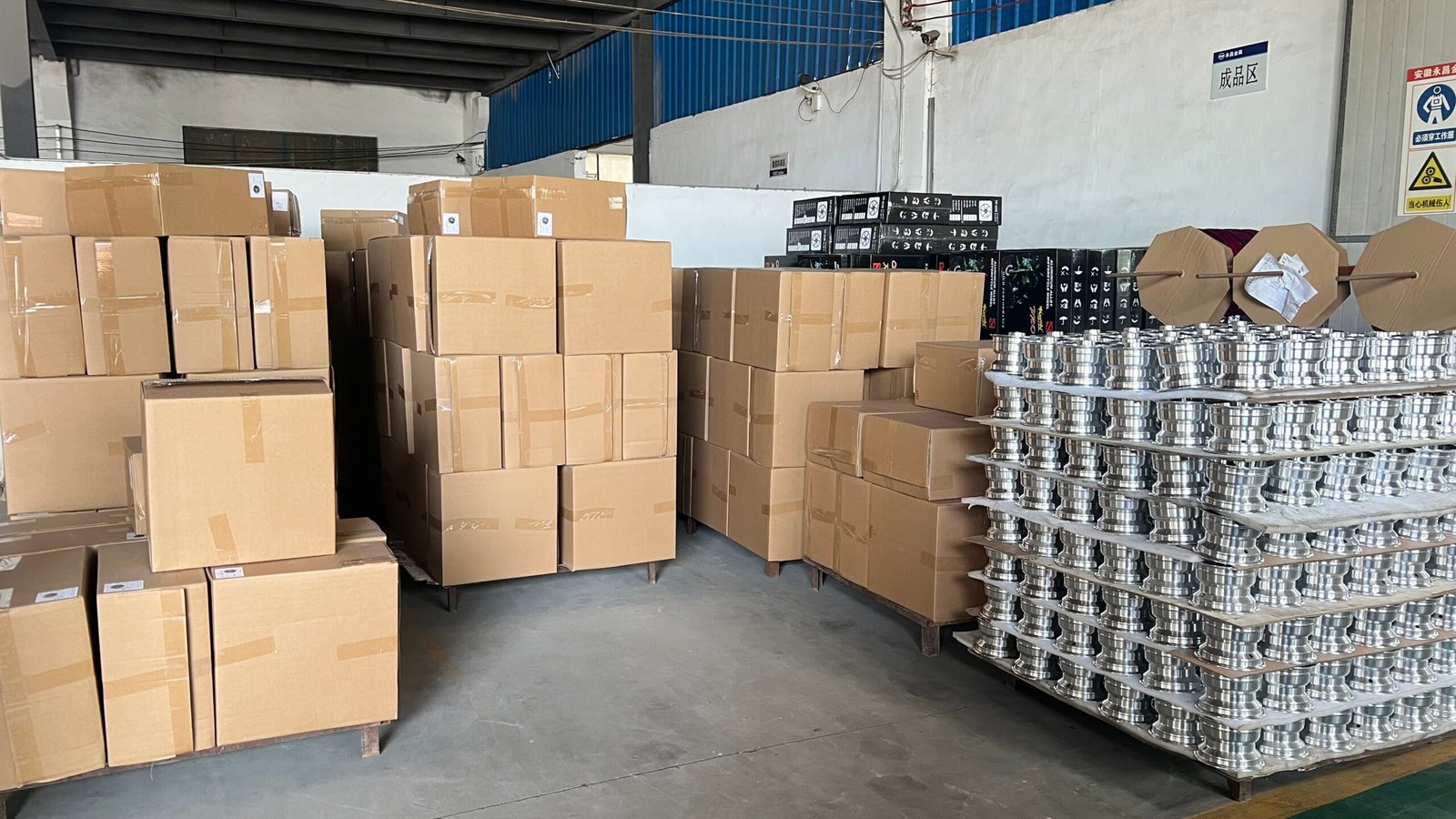
The sequence that works for new brands is: sample set → fitment and finish validation → small first production run → restock based on real sell-through. At FLEXIMOTO the minimum order is one set (front and rear), so you can validate a design without funding a container. Sample lead time is 25–30 days, and bulk production runs 30–45 days after sample approval. Plan backwards from your launch date — if you want stock on the shelf for spring, sampling should start in the previous autumn.
One more consideration: freight cost per wheel drops sharply when you consolidate. If you are also planning swingarms, CNC billet parts or titanium hardware under the same brand, sourcing them from one supplier means one shipment, one set of documents and one point of accountability.
What to Send Us for an Accurate Quote
Brand projects move faster when the first email contains the specification. Send:
- Target segment and bike models (make, model, year)
- Wheel size × width, front and rear
- Axle diameter, and single-sided or dual swingarm
- Brake disc PCD and ABS ring requirement, if known
- Design direction — your drawing, a 3D render, or reference images
- Branding requirements: engraving, center caps, packaging
- Quantity per SKU and destination port
- Target market, so we can discuss documentation requirements
We quote within 48 hours of receiving a complete specification.
Why New Brands Start With FLEXIMOTO
FLEXIMOTO (FlexiTech International LLC) manufactures forged, cast, laced and magnesium forged motorcycle wheels on its own forging and CNC lines in Chongqing, China — we are not a trading company. Beyond wheels we produce swingarms, CNC billet components such as triple clamps, rearsets and levers, and Grade 5 titanium hardware, which allows a new brand to expand its catalogue without adding suppliers. Every custom project runs through 3D render approval before production, and orders ship in export-grade packaging on EXW, FOB or CIF terms to the US, Europe and Australia.
Frequently Asked Questions
Can I put my own logo on the wheels?
Yes. We laser-engrave or CNC-engrave your brand name on the spoke face or rim barrel, and we can produce branded center caps and packaging. Send your logo as a vector file and we will show the placement on a 3D render before production starts.
What’s your MOQ if I’m just launching my brand?
Our minimum is one set — front and rear. That lets you validate a design, check fitment on a real bike and photograph the product before you commit to inventory.
How long does it take from first sample to my first shipment?
Sample lead time is 25–30 days. Bulk production runs 30–45 days after you approve the sample. Add your shipping transit time on top of that when planning a launch date.
Will you sell my design to another customer?
If the design is developed exclusively for your brand from your drawing or concept, we keep it exclusive to you. Tell us at the quotation stage whether you need exclusivity, because it affects how the design is developed and quoted.
Do I need certification to sell motorcycle wheels in my country?
It depends on your market. Japan references JWL and VIA, the United States applies FMVSS/DOT rules, Europe uses ECE / E-mark approval and Australia applies ADR requirements. Tell us your destination market at the quotation stage and we will confirm exactly which test reports and documentation we can supply for your project.
Can I source parts other than wheels for my brand?
Yes. We also manufacture swingarms, CNC billet parts including triple clamps, rearsets, levers and covers, and Grade 5 titanium hardware. Sourcing them together means one production schedule, one shipment and one set of export documents.
Start Your Wheel Brand
Send us your specification and we will come back within 48 hours with pricing, lead time and a branding plan for your first SKU. Email jackie.wei@fleximotoracing.com.
Include in your message: Bike model & year · Wheel size × width (front & rear) · Axle diameter · Quantity · Destination port · Your email